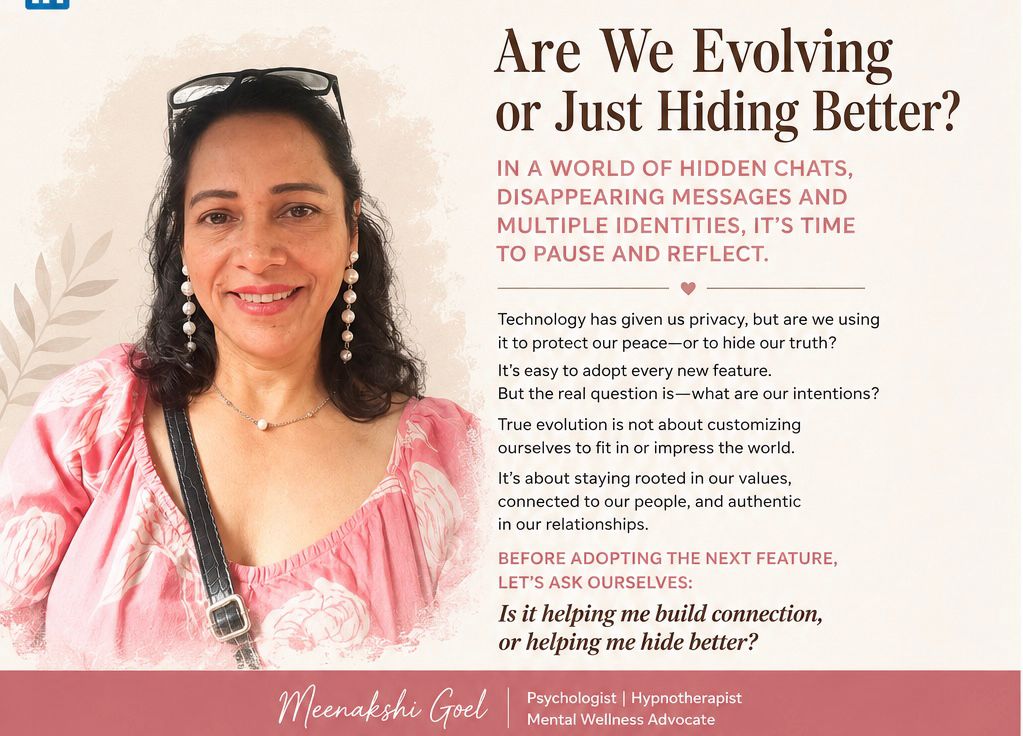
Are We Evolving or Just Hiding Better?
By Psychologist & Hypnotherapist Meenakshi Goel
Every few months, a new feature appears on our phones.
Locked chats.
Disappearing messages.
Hidden folders.
Private accounts.
Multiple identities.
Secret stories.
Passwords within passwords.
And each time, society embraces them as signs of progress.
But perhaps it is time to ask a deeper question:
Are we truly evolving, or are we simply becoming better at hiding?
Technology has given us unprecedented control over what others can see. Yet while our devices have become smarter, many of our relationships seem to be becoming more fragile.
We now live in a world where people know how to lock a chat but struggle to unlock a conversation.
Where they know how to create privacy settings but struggle to create emotional safety.
Where they know how to maintain multiple identities but find it difficult to maintain one authentic self.
I often wonder whether we are confusing privacy with growth.
Privacy can be healthy. Every individual deserves personal space, dignity, and autonomy.
But there is a difference between protecting one’s boundaries and building invisible walls.
The concern is not the existence of privacy features.
The concern is our growing fascination with secrecy.
Many people are rushing to adopt every new digital feature simply because it exists. We fear being left behind. We want to appear modern, informed, technologically updated, and socially relevant.
But in that race, we rarely stop to ask:
What is my intention?
Am I using this feature because it genuinely serves a purpose?
Or am I using it because everyone else is?
Am I becoming more authentic?
Or am I carefully fabricating versions of myself for different audiences?
Modern culture often celebrates customization.
Customize your profile.
Customize your identity.
Customize your image.
Customize what others can see.
Customize what they cannot.
Yet excessive customization can slowly distance us from our roots.
We begin shaping ourselves to fit expectations rather than discovering who we truly are.
That is not evolution.
Evolution brings greater awareness, integrity, and connection.
What we often see today is something different—a subtle fragmentation of the self.
A person who presents one version to family, another to friends, another online, and another in private.
The result is not freedom.
The result is exhaustion.
And often, loneliness.
Human beings are not designed merely to be seen.
They are designed to be known.
Throughout history, families were built upon values that created emotional security:
Trust.
Transparency.
Sharing.
Accountability.
Connection.
No family was perfect, but these values formed the foundation of belonging.
Today, those foundations are increasingly being redefined.
When secrecy becomes normal, trust becomes harder to build.
When hiding becomes effortless, honesty requires courage.
When every conversation can be concealed, relationships may begin to lose the openness that once strengthened them.
The question is not whether technology is good or bad.
The question is whether we are using technology consciously.
As a society, we may need to pause and reflect.
Not every feature requires adoption.
Not every trend requires participation.
Not every innovation represents progress.
True progress is not measured by how many features we know how to use.
It is measured by how deeply we remain connected—to ourselves, to our values, and to the people who matter most.
Perhaps the real challenge of our generation is not learning how to hide more effectively.
Perhaps it is learning how to remain authentic in a world that constantly offers new ways to disappear.
Before embracing the next feature, the next platform, or the next digital trend, we may need to ask ourselves a simple question:
Is this helping me build stronger relationships, deeper trust, and a more authentic life—or is it simply helping me hide better?
Psychologist Meenakshi Goel
Are We Evolving or Just Hiding Better ?